 Get 5% cash back on your AWS bill from day one.Learn more →Get 5% cash back on your AWS bill from day one.Learn more →
The Cost of Compute 2026
How 100 CFOs are approaching cloud costs in 2026.
Cloud Infrastructure Accounting Standards
GAAP-aligned principles for cloud and AI cost classification.
Cloud Finance Learning Center
Practical guides for cloud-aware finance teams.
What 100 CFOs reveal about AI's impact on the P&L.


Report
The Cost of Compute 2026
What 100 CFOs revealed about cloud costs and how it impacts their P&Ls.
Get the reportOpenAI's Guaranteed Capacity is the latest signal that multi-year compute commitments are becoming standard across every major provider. Ed Barrow explains why stacked commitments require a portfolio view - and what Finance leaders should be asking before the next one lands.
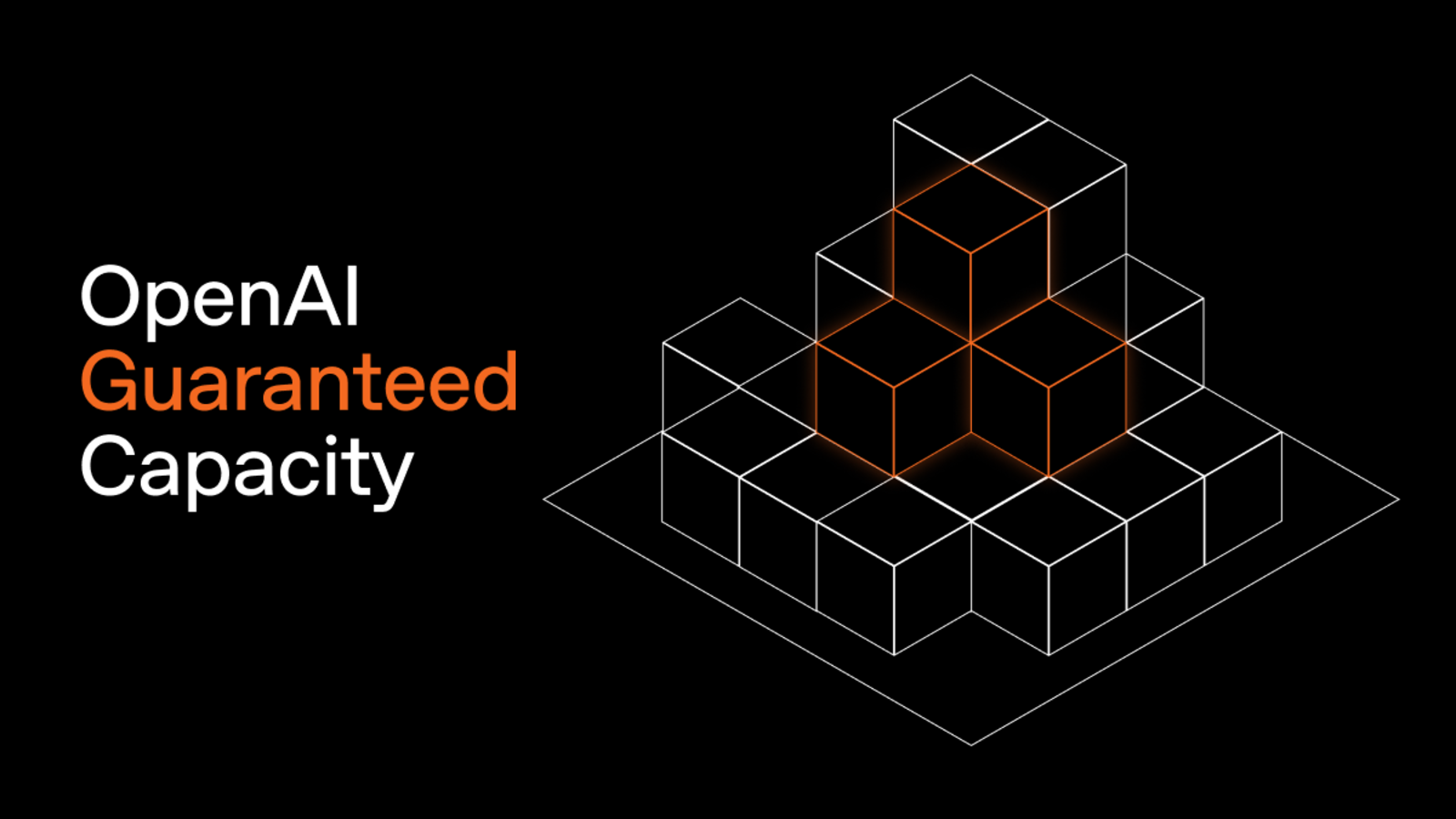
Last week OpenAI launched Guaranteed Capacity. Customers can now lock in one to three years of compute access in exchange for tiered discounts that scale with annual commitment. The offering covers production systems, agents, and customer-facing applications across OpenAI's product portfolio.
Sam Altman framed the launch as a response to customer demand: "Customers are increasingly asking us for certainty on capacity. As models get better, we expect that the world will be capacity-constrained for some time."
It's a familiar shape. AWS has been selling the same trade for over a decade through Savings Plans and Reserved Instances. The mechanics are identical. The customer absorbs utilization risk in exchange for a unit-price discount. The provider gets demand visibility in exchange for a multi-year promise. Both sides walk away claiming a win.
For most finance leaders, the multi-vendor commitment portfolio is a near-future state. Many AI-native companies don't yet hold any multi-year compute commitments. Plenty of others hold one with a hyperscaler like AWS and nothing beyond it. That window is closing fast, and the discipline to manage what's coming should be built before the second and third commitments land.
Even a single commitment is rarely well-handled. At most growth-stage companies, engineering or operations runs the renewal conversation with a hyperscaler like AWS. Finance sees the deal after it's signed. The spend lands in COGS, where it compresses gross margin with no clear owner.
If that's the state of play at one vendor, the multi-vendor version will be harder.
OpenAI is one signal. GPU clouds selling reserved capacity is another. The category of products bundling compute access with multi-year minimums is expanding. Within twenty-four months, most AI-native finance functions will be holding three or four of these contracts, each with its own tenor, its own draw-down rules, its own utilization metrics, and its own counterparty.
A few things compound as the portfolio forms.
Utilization risk multiplies. One under-consumed commitment looks like a forecasting miss. Three or four under-consumed commitments look like a structural over-buy. The aggregate write-off is real money the business will not recover, and it lands directly in COGS.
Optionality erodes. Each commitment locks the company into a vendor's product roadmap. A team that committed to a model family in 2025 may find itself paying full rate on the model family it actually wants to use in 2027. Model capabilities move faster than commitment terms. A three-year lock-in is half a generation of model progress.
Coordination breaks down. The contracts arrive on different desks at different times. The AWS commit gets renewed in March by a sourcing lead. The OpenAI deal gets signed in July by an engineering leader who already had budget approval. The GPU minimum gets bundled into a vendor consolidation in September. No single person sees all three move, and no one owns the aggregate position.
Stacked compute commitments behave more like a treasury portfolio than a procurement line. The finance team that treats them as procurement is reading the wrong line on the wrong statement.
What compute commitments does the company hold today, and what's the realistic utilization range against each one? The original deal memo's forecast rarely matches what shows up in production.
If we don't hold any commitments yet, who has the authority to sign the next one? Sometimes the answer is uncomfortable. The authority sits with engineering or operations, and finance won't be in the room.
When the second and third commitments arrive across vendors and model providers, who owns the portfolio view? The honest answer at most companies is that no one does yet.
If none of these answers exists today, that itself is the finding. The portfolio is forming whether or not anyone has built the discipline for it.
AWS sells capacity certainty through Savings Plans. GPU clouds sell it through reserved capacity. OpenAI now sells it through Guaranteed Capacity. Every compute provider eventually monetizes commitment risk, because the discount on offer is real and the demand visibility is valuable.
Commitment risk is becoming a product category. Every CFO running an AI-native or AI-heavy business will hold a portfolio of these contracts within the next twenty-four months. The CFOs who see the shape forming first will have an easier time modeling, hedging, and explaining it to their board than the ones who recognize it after the third contract has been signed.
The portfolio is coming. The question for finance leaders is whether it will be managed actively or accumulated by default. The answer determines whether stacked compute commitments behave like leverage on the balance sheet or like dead weight.
Report
Download The Cost of Compute 2026
Cloud Capital earns a share of the savings we generate for you. If you don't save, we don't get paid. Our incentives are fully aligned with yours. Ready to take control of your cloud spend?


