 Get 5% cash back on your AWS bill from day one.Learn more →Get 5% cash back on your AWS bill from day one.Learn more →
The Cost of Compute 2026
How 100 CFOs are approaching cloud costs in 2026.
Cloud Infrastructure Accounting Standards
GAAP-aligned principles for cloud and AI cost classification.
Cloud Finance Learning Center
Practical guides for cloud-aware finance teams.
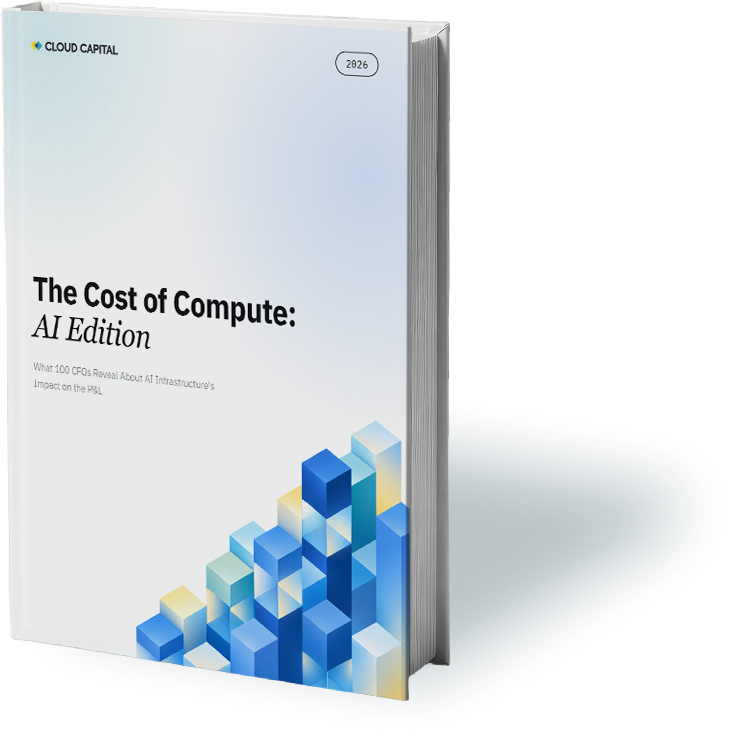
What 100 CFOs reveal about AI's impact on the P&L.

DOWNLOAD REPORT

SHARE
INTRODUCTION
Cloud infrastructure now represents the second-largest expense for many growth-stage SaaS companies. Finance tightly controls expenses at this scale. Yet cloud infrastructure fluctuates at 5-10% or higher monthly variance for 74% of CFOs.
The financial consequence is now unmistakable: 89% of CFOs report that rising cloud costs have negatively impacted gross margins over the past 12 months. When a significant component of COGS moves unpredictably month to month, Finance loses the ability to defend margin projections with the precision boards expect. The traditional model (delegated ownership, reactive controls) cannot support an expense at this scale or volatility.
Against this backdrop, we surveyed 100 CFOs and Finance leaders to quantify the gap between predictable and unpredictable forecasters, understand how AI is accelerating the challenge, identify which ownership models deliver control, reveal the operational systems that create precision, and measure how forecast accuracy compounds into margin performance.
Cloud Capital fields this survey annually to track how cloud costs are moving through the P&L.
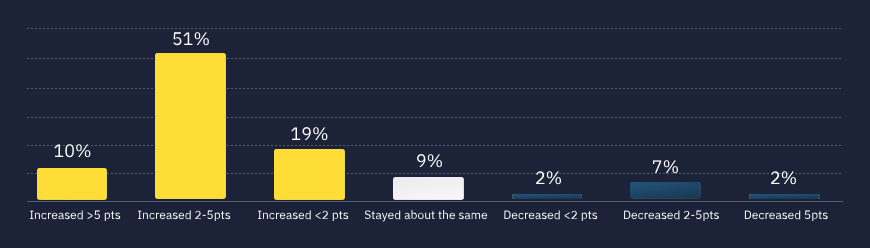
Cloud Spend as a % of Revenue is Increasing
How has your cloud spend as a % of revenue changed in the past 12 months?
Cloud Volatility
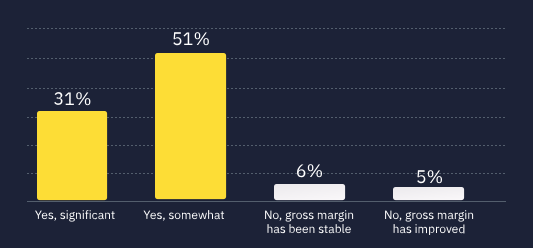
89% of CFOs report that rising cloud costs negatively impacted gross margins over the past 12 months. This is the signal that cloud has crossed from an operational concern into a CFO-level financial risk. When a component of COGS consuming 10-20% of revenue moves unpredictably month to month, gross margin becomes harder to forecast and harder to defend.
The mechanism driving margin pressure is forecast variance. 74% of CFOs report monthly cloud forecast variance of 5-10% or higher. Only 26% achieve the precision Finance expects for expenses at this scale. The full report includes detailed comparative benchmarking showing how cloud variance compares to headcount and fixed expenses, revealing why this volatility gap undermines Finance credibility.
Cloud Spend is Negatively Impacting Margins
Have rising cloud costs negatively impacted your company's gross margins over the past year?
AI Acceleration
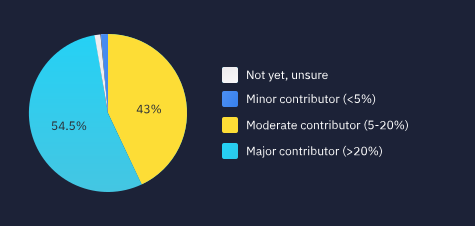
AI workloads already account for 22% of total cloud spend, far earlier and far faster than traditional forecast models assumed. AI introduces cost patterns that behave fundamentally differently: bursty training runs, non-linear inference scaling, experimentation noise. Together, these dynamics break the linear forecasting assumptions Finance relies on.
The margin impact is measurable, but nuanced. While most AI-heavy organizations improved margins, those with major AI workloads show a distinct pattern of margin pressure compared to moderate AI users. The full report breaks down margin trajectory by AI contribution level and explores why Finance is responding with financial guardrails despite clear projected revenue gains.
AI Contribution to Cloud Spend
Is AI/ML contributing materially to your cloud spend today?
AI & Margin Pressure
Heavy Investment in AI innovation is Compressing Margins
Finance Ownership
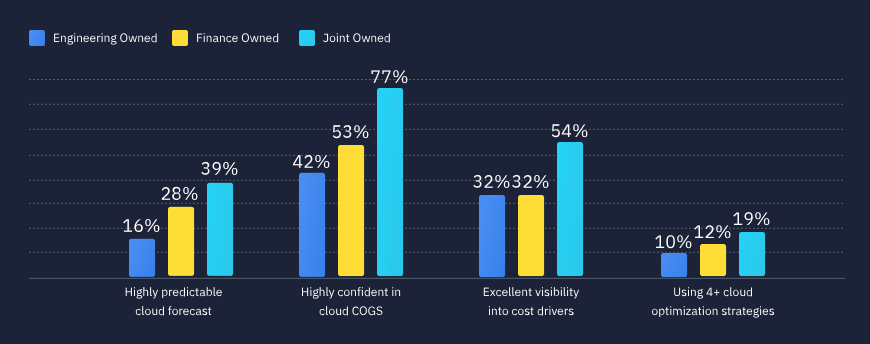
The strongest predictor of cloud cost predictability is who owns the problem. When Finance gets involved in cloud cost management, forecast predictability doubles. Finance-involved teams achieve 32% highly predictable forecasts (less than 5% monthly variance) compared to 16% for Engineering-owned teams. COGS confidence increases 50%, and reported visibility improves 25%.
Joint Finance-Engineering ownership achieves what neither function delivers alone. 39% of joint teams reach highly predictable forecasts, and 77% report high confidence in COGS accuracy. This compares to 28% predictability and 53% confidence for Finance-only teams, and 16% predictability and 42% confidence for Engineering-only teams. The full report reveals performance differences across COGS confidence, visibility, optimization strategies, and margin trajectory.
Forecast Predictability by Ownership Model
% of respondents by ownership model
Three Systems
85% of organizations achieving highly predictable forecasts have fully implemented governance policies. The most predictable forecasters share three operational characteristics: formal controls that prevent runaway costs, visibility systems that track spend in real time, and forecasting rhythms that catch variance before it compounds. Each system independently lifts predictability. Combined, they create the infrastructure Finance needs to manage cloud costs with headcount-level rigor.
Systems Adoption
% highly predictable cloud forecasters reporting systems adoption vs baseline
margin Advantage
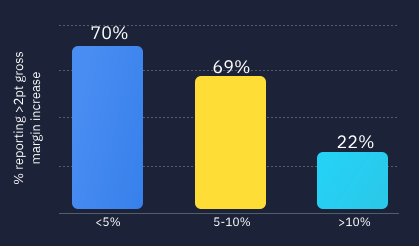
Forecast precision converts cloud spend from an unpredictable variable cost into a governable system, and that structural shift creates compounding margin advantage. Organizations with highly predictable forecasts improve gross margins at 2.8× the rate of unpredictable forecasters. The mechanism is clear: precision enables proactive optimization, better trade-off decisions, and confidence to invest strategically.
Monthly forecasters are 1.5× more likely to improve margins than those who forecast quarterly or less frequently. The report includes side-by-side analysis showing both upside capture (who improves margins) and downside protection (who avoids decline), revealing why 44% of CFOs are already prioritizing cloud forecast accuracy for 2026.
Margin Improvement by Forecast Predictability
Likelihood of margin improvement
The Path Forward
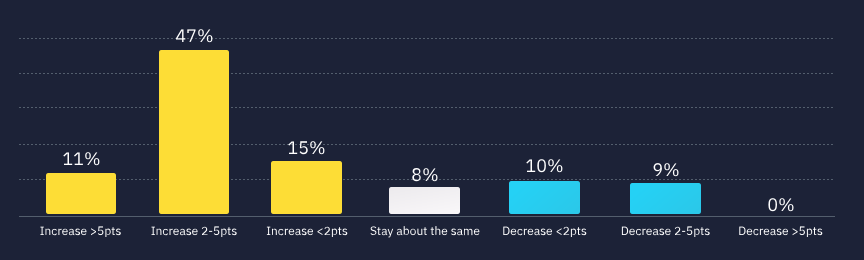
Cloud spend is rising, AI workloads are scaling faster than expected, and variance on a growing cost base compounds into material financial risk. 73% of CFOs expect cloud spend as a percentage of revenue to increase over the next 12 months. The organizations that achieve predictability now will widen the performance gap over the next 12-24 months.
The model is clear: Finance involvement doubles predictability. Joint ownership unlocks best-in-class performance. Governance, visibility, and monthly cadence form the operating system of control. And the business case is measurable: predictable organizations improve margins nearly three times faster. Finance either applies the same rigor to cloud that it applies to headcount and fixed expenses, or accepts ongoing variance on a line item consuming 10-20% of revenue and growing.
Expected Cloud Costs as a % of Revenue Change over the next 12 months
Full Report
Get the complete analysis with all findings, 15+ charts, and best practices from top-performing Finance teams.


