 Get 5% cash back on your AWS bill from day one.Learn more →Get 5% cash back on your AWS bill from day one.Learn more →
The Cost of Compute 2026
How 100 CFOs are approaching cloud costs in 2026.
Cloud Infrastructure Accounting Standards
GAAP-aligned principles for cloud and AI cost classification.
Cloud Finance Learning Center
Practical guides for cloud-aware finance teams.
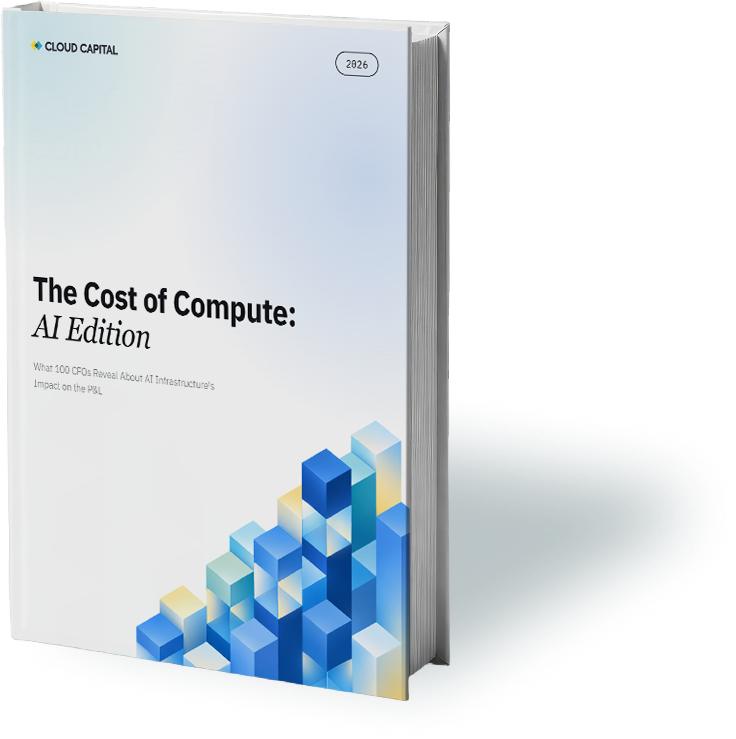
What 100 CFOs reveal about AI's impact on the P&L.


Report
The Cost of Compute 2026
What 100 CFOs revealed about cloud costs and how it impacts their P&Ls.
Get the reportA team scopes a new AI feature. Someone needs a cost estimate, and the number they reach for is the token bill. It makes sense. Foundation model usage has a published per-token price, it arrives on its own invoice, and it is the one line item that announces itself as “AI.”
So when we asked 100 CFOs which AI-related costs had blown past forecast over the past year, we expected the token bill to top the list.
It came in third.
Compute infrastructure topped the list. Among the 100 finance leaders we surveyed, at growth-stage SaaS and AI-native companies, 64% named it among their biggest forecast overruns. Data and storage infrastructure followed close behind at 60%. Foundation model API and token costs landed third, at 47%.
Picture an iceberg. The token bill is the part above the waterline, visible, labeled, easy to point at. Compute, data, storage, networking, and tooling are the mass below it. That is the bill beneath the bill, and it is where forecasts break.

A note on how to read that chart, because it matters. This was a “select up to three” question, so the percentages show how often each category made a company’s short list of worst overruns, not the share of companies that overran on it outright. The ranking is the signal. And the ranking is consistent: compute and data outrank the model bill as the place forecasts break.
The broader result sets the stakes. Only 4% of respondents said nothing had materially exceeded forecast.
Forecast misses on AI are close to universal, and they cluster below the waterline, in the parts of the stack that do not look like “AI” on an invoice.
There is a clean reason the token bill behaves and the rest of the stack surprises.
The token bill is legible. It has a unit price you can multiply, a dedicated invoice you can track, and a vendor who publishes its rate card. That makes it the easiest AI cost to forecast, and the one teams anchor on.
The compute, data, storage, networking, and tooling required to build, serve, and support that same AI feature are a different matter. They are larger, they are spread across the general infrastructure bill rather than tagged as AI, and no single invoice announces them.
There is also a reason the model bill is shrinking as a share of the problem even as the problem grows. The price per token keeps falling, while the work per task keeps climbing as products lean on heavier reasoning and multi-step workflows. The visible line gets cheaper per unit while the infrastructure underneath it carries more load. So the cost most teams watch most closely is the one giving them the least trouble, and the lines below the waterline absorb the surprise.
The survey shows the pattern without claiming to explain every cause, but the shape is hard to miss: teams forecast the cost they are watching and under-scope the cost they are not. The overruns land where attention is thinnest.
There is a ledger dimension to this too, and it is where the blind spot gets structural. Much of the attention on AI cost today sits on the operating-expense side, the AI coding tools and agents a team uses to build and run the business. That spend scales with headcount and it is easy to watch.
The bill beneath the bill lives on the other side of the ledger: the production compute and data your product consumes every time a customer uses an AI feature. That is a cost of goods sold, it scales with customers rather than headcount, and it grows with every AI feature you ship. The forecast misses concentrate there, in the quadrant most finance teams are not yet watching.
For a finance leader, the reframe is the whole point. AI cost is a full-stack infrastructure question, and scoping it as a model-pricing question is what leaves the forecast exposed.
The bill beneath the bill is not identical for every company. Where it hides depends on how the company is built, and the survey shows two distinct patterns.
For AI-native companies, where the AI is the core product, compute is the clear problem. It topped their overrun list by a wide margin, named far more often than the token bill. These companies tend to own more of their stack, running and serving models on infrastructure they manage directly, so raw compute is what escapes the estimate. The foundation model bill, by comparison, sits low on their list.
For AI-enabled SaaS companies, where AI features are added to an existing product, the picture shifts. The token bill climbs to roughly level with compute, and data and storage ranks at or above both. These companies more often consume AI through third-party APIs, so the model invoice is a live source of surprise in a way it is not for the companies running their own inference.
Read these as directional patterns rather than precise head-to-head figures, given the question let respondents pick up to three. The practical takeaway holds either way.
Same headline cost problem, two different failure points. Before you tighten a forecast, it is worth knowing which version of the bill beneath the bill applies to your company.
Here is the result that reconciles the whole picture, and it has to be read as a pair.
96% of companies had at least one AI cost category exceed its forecast. Yet 90% reported that their total AI spend still landed within 10% of forecast.
At first glance those two numbers seem to argue with each other. They do not. Together they are the tell.
Companies are holding the aggregate steady by absorbing a constant stream of category-level surprises underneath it. One line runs hot, another comes in soft, and the total lands close to plan. That is not evidence the cost is easy to forecast. It is evidence of active, ongoing effort to keep a messy set of components adding up to a number leadership can trust.
The risk in that arrangement is quiet. If your forecast only scopes the model bill, your total may be landing despite your process rather than because of it. That holds right up until the infrastructure lines move together in the same direction, at which point the aggregate stops absorbing and the overrun reaches the bottom line.
The companies that stay ahead of this do two things. They scope AI cost across the full stack, compute and data and storage and networking and tooling, not just the model invoice. And they attribute it precisely enough to see which line is actually moving, early enough to act.
The forecast holds because the bill beneath the bill is visible to them, not because it is small.
Picture that team again, scoping the new feature, reaching for the token bill. The number they reach for is real. It is just not the one most likely to break their forecast.
The visible cost of AI rarely is. The forecast breaks on the bill beneath it: the compute, the data, the storage that carry the model but never carry its name.
The first move is small. Pull your AI cost apart by category, not as one “AI” line, and see which part actually moved last quarter. Finance leaders who scope the full stack, and who can see which part of it is moving, are the ones whose forecasts will hold.
The full breakdown, across every cost category, forecast accuracy, and how companies are pricing to recover these costs, is in The Cost of Compute: AI Edition.
Report
Download The Cost of Compute 2026
Cloud Capital earns a share of the savings we generate for you. If you don't save, we don't get paid. Our incentives are fully aligned with yours. Ready to take control of your cloud spend?


