 Get 5% cash back on your AWS and Google Cloud bills from day one.Learn moreGet 5% cash back on your AWS and Google Cloud bills from day one.Learn more
The Cost of Compute 2026
How 100 CFOs are approaching cloud costs in 2026.
Cloud Infrastructure Accounting Standards
GAAP-aligned principles for cloud and AI cost classification.
Cloud Finance Learning Center
Practical guides for cloud-aware finance teams.
What 100 CFOs reveal about AI's impact on the P&L.

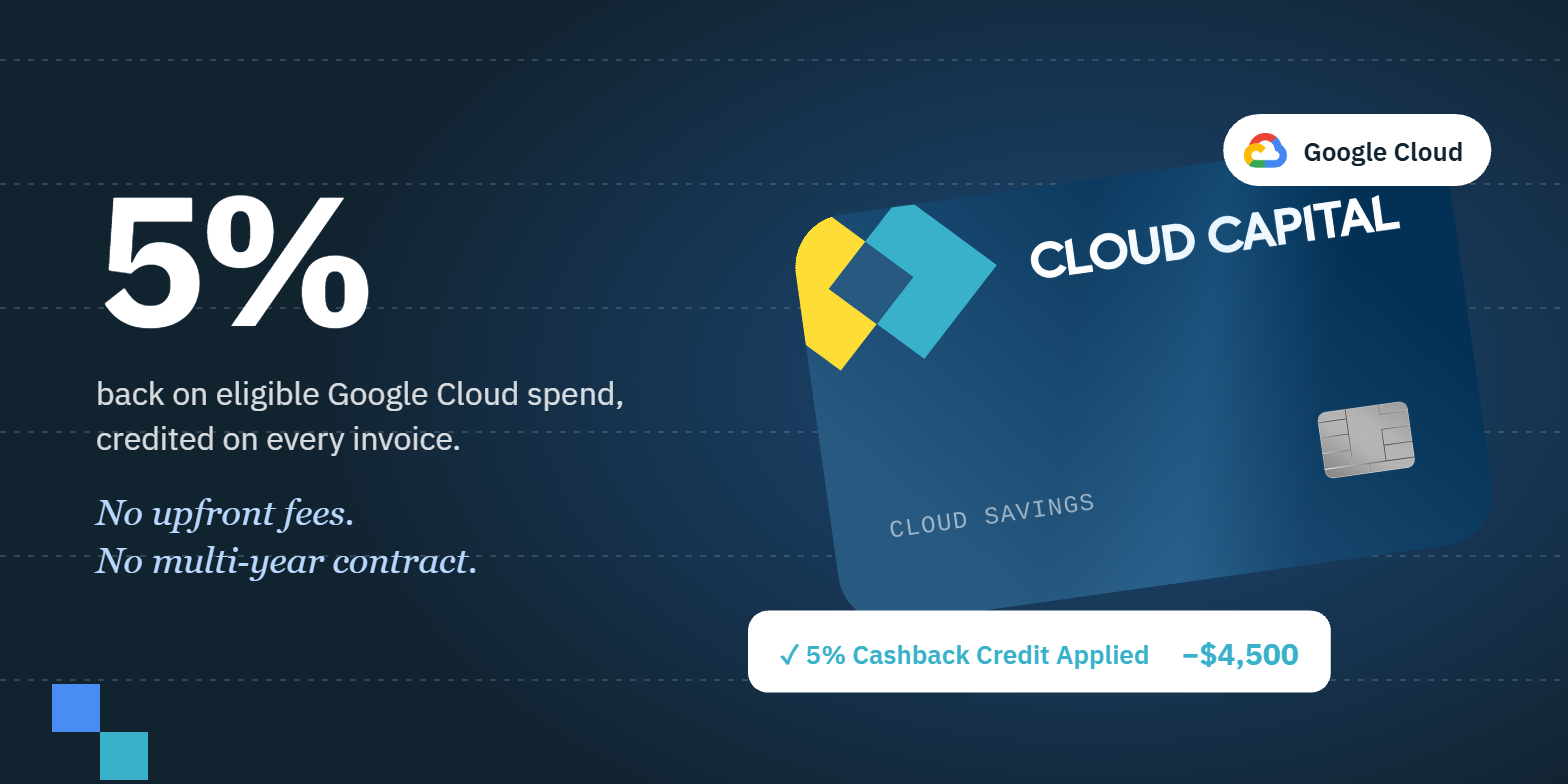
Cloud Capital is now a Google Cloud partner. Starting today, you can see your Google Cloud spend alongside the rest of your cloud and AI costs, forecast where it's heading, and get 5% of eligible spend back every month.
Today, cloud is one of the largest costs for most software companies, and it keeps growing. In our Cost of Compute survey, 89% of CFOs said rising cloud costs hurt their gross margins over the past year, and 73% expect cloud to take a bigger share of revenue over the next one.
Much of that growth is coming from AI (already 22% of cloud spend on average), creating pressure in two directions: engineering is expected to build with AI as fast as possible, while finance is expected to protect margin and runway.

You'd never let payroll grow that fast without knowing who you were hiring and why. Yet cloud still arrives as a black box. The bill shows a bigger total every month, but only engineering knows why. We started Cloud Capital to give that bill the same clarity as every other line on the P&L.
Cloud Capital is now a Google Cloud partner, which brings our visibility, forecasting, and 5% cashback to Google Cloud customers. Getting started doesn't touch your infrastructure. You move your Google Cloud billing to us and connect read-only cost data, and your projects, permissions, and workloads stay exactly as they are. Your 5% cashback starts on the 1st of the following month.
When you bring your Google Cloud spend into Cloud Capital, the first thing you get is a clear view of what you're spending today. It's broken down by product, team, and environment, so the next time the number jumps, you can see exactly where it jumped.
If you run on more than one cloud, the view gets even more useful. Maybe AWS hosts your core product, Google Cloud runs your data stack, and your AI spend is scattered across Anthropic, OpenAI, and a growing pile of Cursor seats. Each arrives as its own invoice, in its own format, on its own schedule. Cloud Capital pulls them into one place, so you can finally answer the question your board will eventually ask: what do we spend on infrastructure, all in?
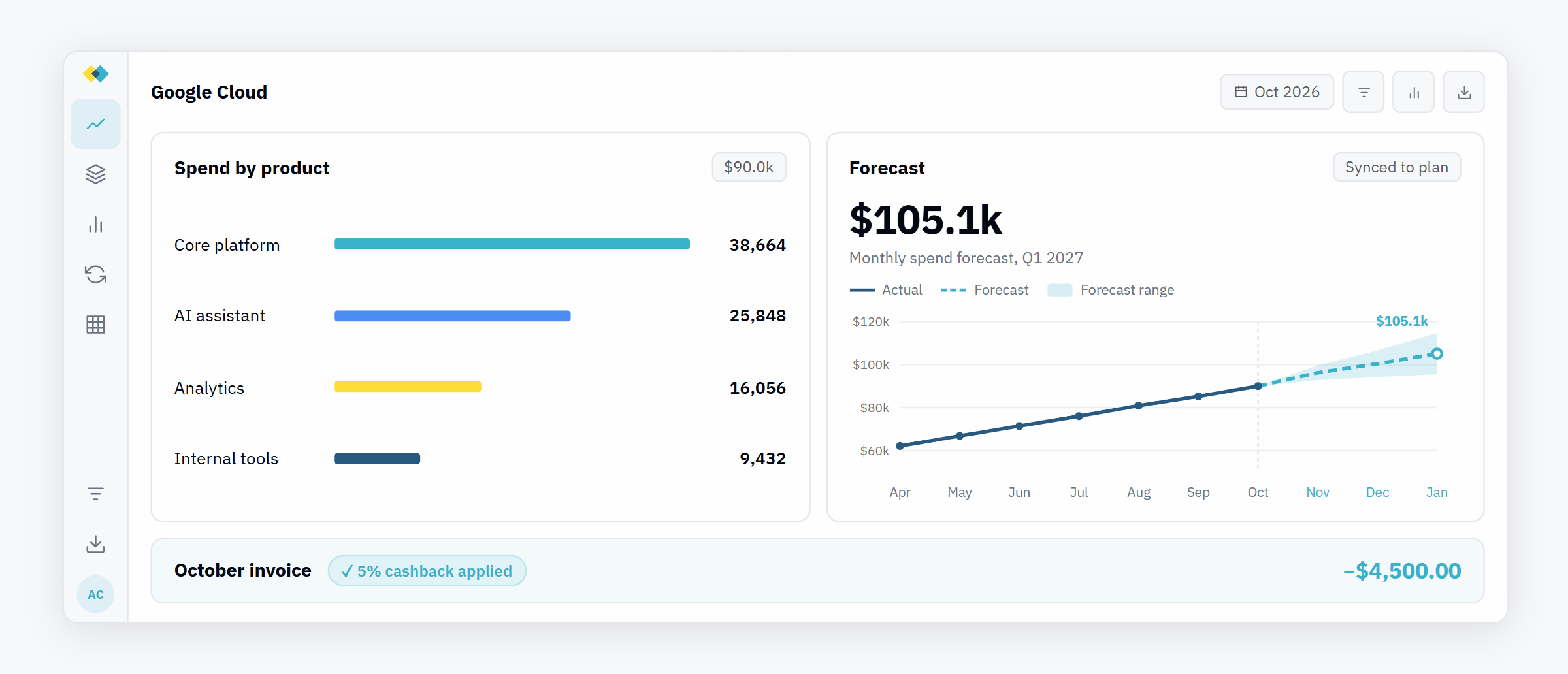
Beyond today's spend, Cloud Capital forecasts where your cloud spend is heading. The forecast updates as your usage changes, so you see shifts coming weeks before they reach an invoice. When engineering plans a migration or an AI launch, it goes into the forecast, and everyone knows the cost before anyone hits deploy.
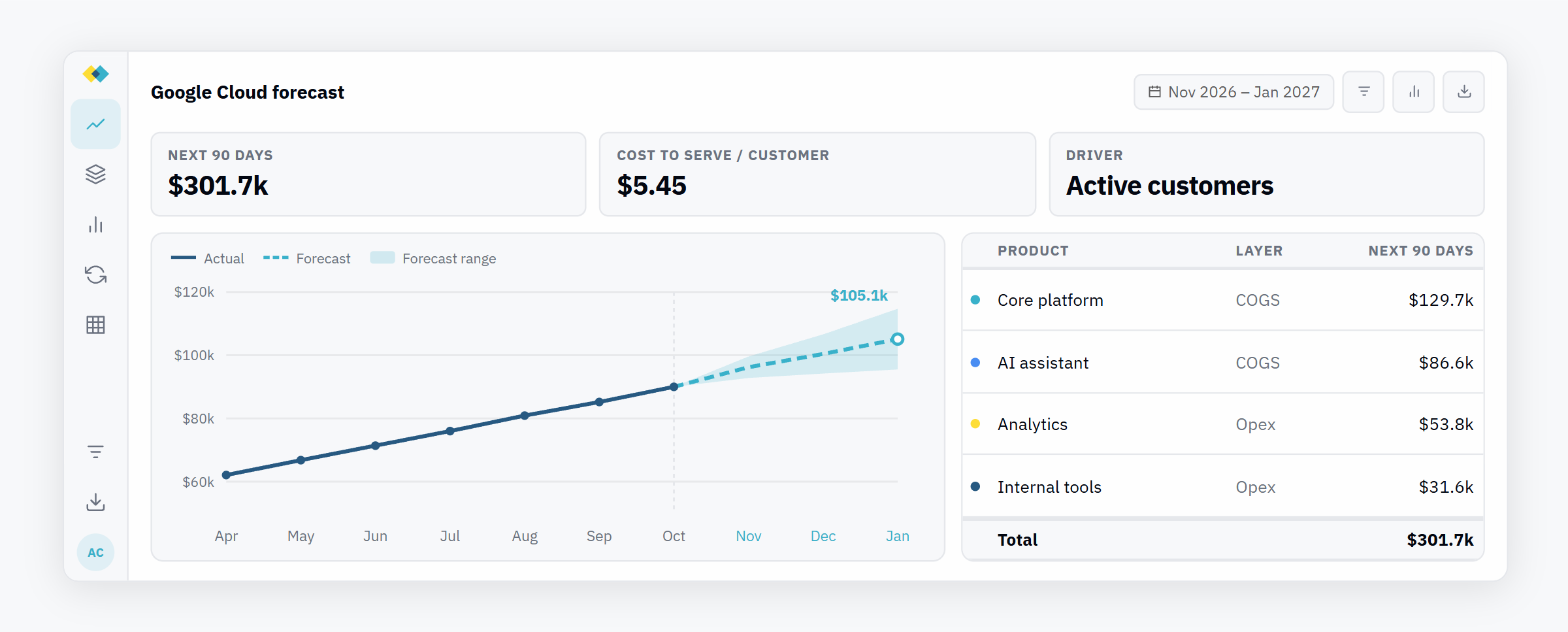
You choose the business metrics the forecast is tied to, whether that's active customers, transactions, model calls, or something only your business tracks. When it says your Google Cloud spend over the next 90 days will land at about $300,000, you can see which products put it there and what each customer costs to serve. Spend is mapped to COGS and opex too, so the gross margin you report holds up when someone asks how you got there.
Because the forecast runs on those metrics, you can also test what-ifs before they happen. Lose a major customer, sign a big one, or double your AI usage, and you'll see what each does to your forecast.
Cloud providers pay their partners a margin on the usage those partners bring in. If you buy through another partner, someone has probably been collecting that margin on your spend for years. If you buy direct, nobody has ever offered it to you.
Most partners keep it. We pass ours through to you as 5% cashback on eligible Google Cloud spend, credited on every invoice, on the same terms our AWS customers already get. There are no upfront fees or subscription costs.

You can put it toward an AI project or let it fall to gross margin. Cashback covers the first $100,000 of eligible spend each month. For larger bills, ask us about your full spend. There's no multi-year contract, and the credit continues for as long as your billing runs through us.
For years, engineering owned cloud usage and finance owned the budget, and both did good work with the view they had. AI has made that split harder to sustain. Neither side can see the whole picture from where it sits.
Cloud Capital gives both teams one model to plan from, so cost conversations take minutes instead of a week of back-and-forth.
With Cloud Capital, your Google Cloud bill gets 5% cheaper, and it lands where your forecast said it would.
Get a free savings estimate for your Google Cloud bill, and we'll walk through the numbers with you on a short call. Bring someone from engineering so both teams get their questions answered.
Cloud Capital earns a share of the savings we generate for you. If you don't save, we don't get paid. Our incentives are fully aligned with yours. Ready to take control of your cloud spend?