 Get 5% cash back on your AWS bill from day one.Learn more →Get 5% cash back on your AWS bill from day one.Learn more →
The Cost of Compute 2026
How 100 CFOs are approaching cloud costs in 2026.
Cloud Infrastructure Accounting Standards
GAAP-aligned principles for cloud and AI cost classification.
Cloud Finance Learning Center
Practical guides for cloud-aware finance teams.
What 100 CFOs reveal about AI's impact on the P&L.

Report
The Cost of Compute 2026
What 100 CFOs revealed about cloud costs and how it impacts their P&Ls.
Get the reportCloud infrastructure has crossed the threshold where Finance expects tight control. At 10-20% of revenue, it's the second or third-largest expense category after headcount. But most organizations still operate with legacy ownership models: Engineering manages the infrastructure, Finance gets the bill.
That model is failing. 74% of CFOs report monthly forecast variance of 5-10% or more on cloud spend, and 89% report cloud costs have negatively impacted gross margin over the last 12 months.
Our research on 100 CFOs at growth-stage SaaS companies found one variable that predicts forecast precision and margin control better than tools, team size, or spend level: who owns the problem. And the answer isn't Finance or Engineering. It's both.
This analysis draws on Cloud Capital's Q4 2025 CFO Survey of 100 senior finance leaders at growth-stage technology companies (50–1,000 employees, US and UK). All margin and forecast references reflect the 12 months preceding the October 2025 survey. For full methodology, see The Cost of Compute 2026.
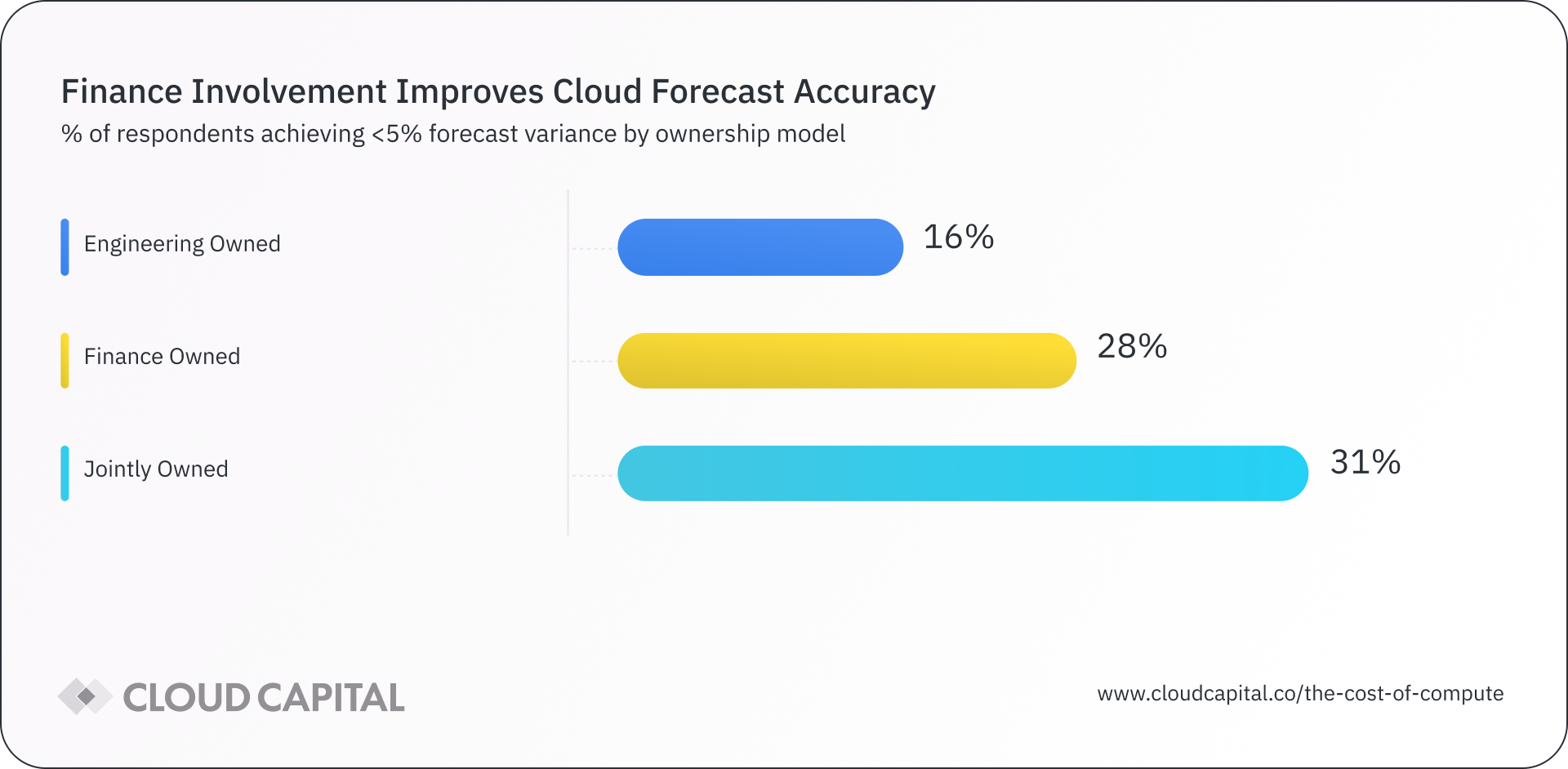
When Finance owns cloud cost governance and forecasting, forecast predictability nearly doubles.
28% of Finance-owned teams achieve highly predictable forecasts (less than 5% monthly variance). For Engineering-owned teams, that number is 16%. The gap is structural.
Finance-owned organizations forecast cloud costs the way they forecast headcount: with budget authority, reforecasting cycles, and variance accountability. When a new product launch spikes compute costs by 15%, Finance-owned teams catch it in the monthly review and adjust the forecast. Engineering-owned teams discover it when the invoice arrives.
COGS confidence follows the same pattern. 53% of Finance-owned teams report high confidence in their cloud COGS accuracy, compared to 42% for Engineering-owned teams. When Finance isn't accountable, the numbers that flow into gross margin calculations carry more uncertainty.
But Finance ownership alone has limitations. Finance can detect variance early, but often lacks the technical context to act surgically. Without Engineering's input, governance defaults to blunt constraints ("cut 10% across the board") rather than architectural tradeoffs that preserve critical workloads.
The best results require both functions at the table.
Joint Finance-Engineering ownership achieves what neither function delivers alone. Across every metric we measured, regardless of company size or maturity, joint teams outperform single-owner models.
39% of jointly-owned teams reach highly predictable forecasts. That's more than double the rate of Engineering-owned teams, and 10 percentage points higher than Finance-owned teams. Joint ownership outperforms both single-function models.
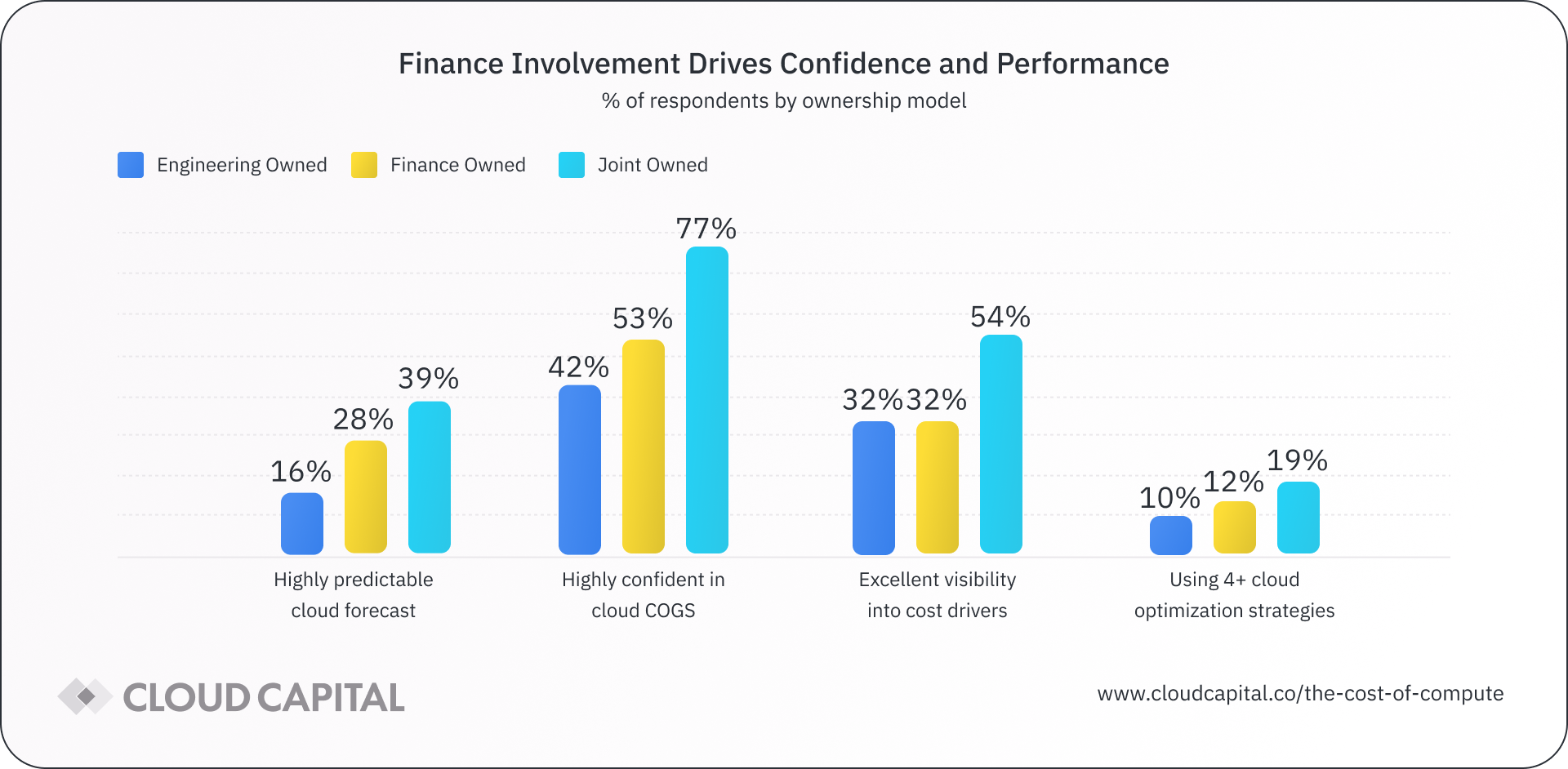
77% of jointly-owned teams report high confidence in COGS accuracy, compared to 53% for Finance-owned and 42% for Engineering-owned. 54% achieve excellent visibility into cost drivers, versus 32% for either single-function model.
The optimization advantage is equally striking. Jointly-owned teams deploy four or more advanced optimization strategies at 42%, compared to 13% for Finance-owned and 21% for Engineering-owned teams. These strategies include reserved instance commitments, cost tagging and allocation by product or customer, anomaly detection alerts, and recurring rightsizing reviews. Shared accountability transforms optimization from reactive cost-cutting into systematic financial discipline.
Why does joint ownership outperform? Because neither function alone has the complete picture.
Finance understands budget cycles, variance thresholds, and what the board expects. Engineering understands workload drivers, architectural tradeoffs, and which costs are discretionary versus load-bearing. Finance without Engineering creates policies that don't reflect technical reality. Engineering without Finance optimizes for performance metrics rather than financial outcomes. Joint ownership closes both gaps.
Joint ownership means Finance takes accountability for forecasting and governance while Engineering owns execution. Engineering keeps operational control of infrastructure.
For Engineering leaders, this model solves real problems. Fewer fire drills when the monthly bill lands 12% over forecast and Finance needs answers by end of day. Clearer priorities about what's worth optimizing versus what's load-bearing spend that shouldn't be touched. And critically, the ability to defend necessary investments with data rather than assertions.
Joint ownership also reduces unplanned optimization mandates. When Finance and Engineering share visibility into cost trajectories, mid-quarter "cut 10% immediately" directives become rare. Engineering can plan optimization work into the roadmap rather than scrambling to find savings while maintaining uptime.
When Engineering proposes a $200K training run or a new inference cluster, joint ownership means Finance has already seen the cost drivers. The conversation becomes "how does this fit the quarterly envelope?" Engineering gets faster approvals and fewer late-stage rejections. Finance gets fewer surprises.
Joint ownership requires structural commitment:
The mechanism matters. Finance sets the spending envelope and owns variance explanations. Engineering operates within that envelope and provides technical context. When spend exceeds forecast, Finance defines the financial constraint; Engineering identifies the operational levers.
Finance applies the same accountability to cloud that it applies to headcount: clear budget authority, regular forecasting discipline, and responsibility for explaining variances. Engineering owns execution. Finance owns accountability.
Minimum viable joint ownership (30-day version): Finance sets the quarterly cloud spend guardrail (e.g., ≤15% of revenue) and runs a monthly driver-based forecast. Engineering maintains tagging and allocation discipline and owns the optimization backlog. The team reviews one page monthly: actual vs forecast, top three drivers, tag coverage %, and 3-5 actions with owners and expected dollar impact. If projected spend exceeds forecast by more than 5% mid-month, Engineering flags it within 5 business days and Finance updates the forecast before the board narrative gets written.
Finance accountability includes:
Engineering accountability includes:
Shared accountability requires:
The trigger-and-response model captures the dynamic. When cloud spend exceeds forecast, Finance defines the financial constraint ("We need to get back to X% of revenue by end of quarter"). Engineering identifies the operational levers ("We can rightsize the dev environment, delay the training run, or accept 2% slower response times").
Neither function dictates to the other. The CFO who tells Engineering exactly what to cut will likely cut the wrong things. The Engineering leader who tells Finance "costs are what they are" isn't partnering on a material P&L line.
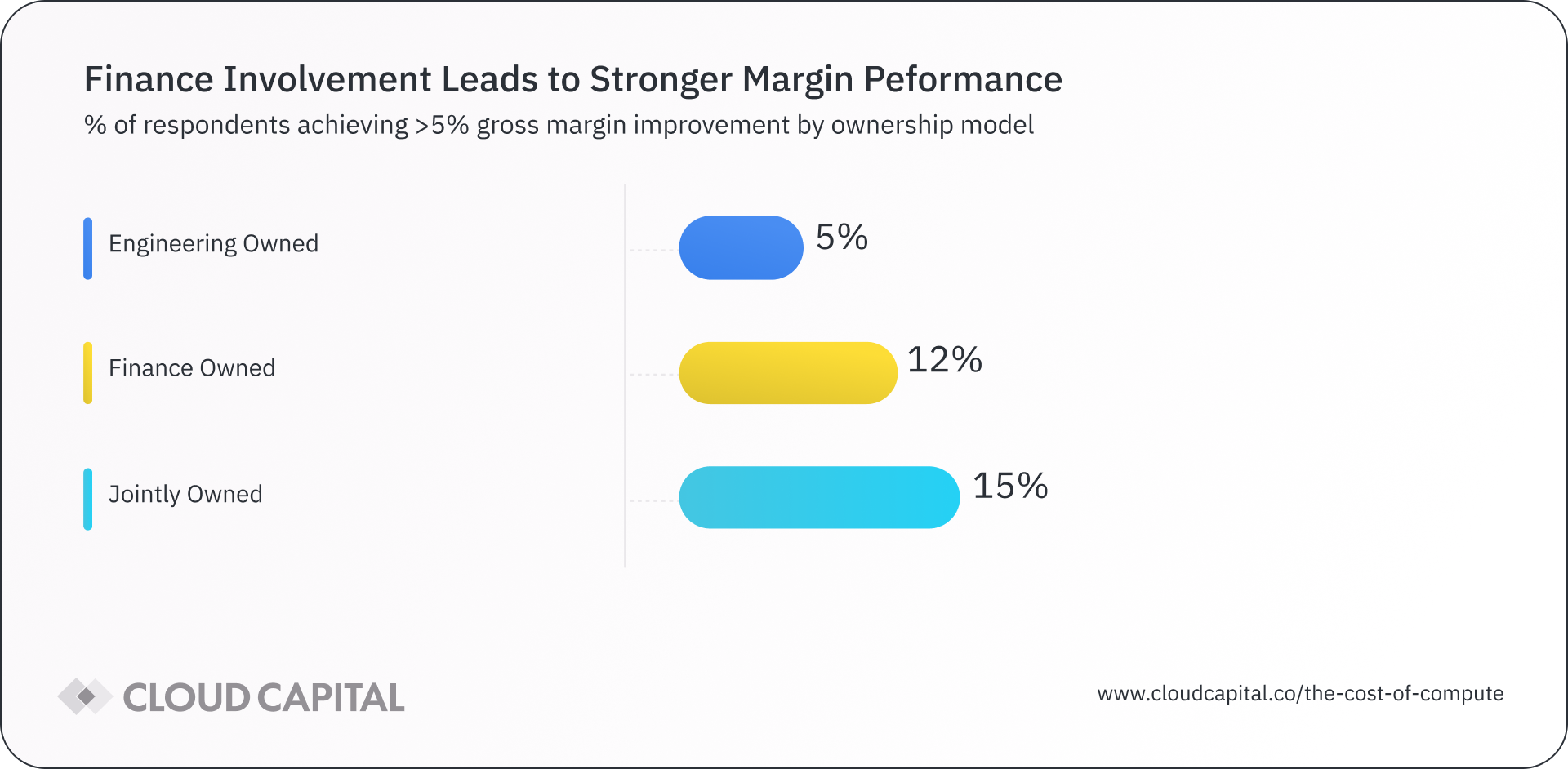
Organizations with joint ownership improve margins at 3× the rate of Engineering-owned teams. The causal chain runs through predictability: joint ownership enables forecast precision, and forecast precision enables the decisions that improve margins.
15% of jointly-owned organizations achieved significant margin improvement (more than 5 percentage points) over the past 12 months. For Engineering-owned teams, that number is 5%. Finance-owned teams fall in between at 13%.
Finance involvement correlates with better margin outcomes. Joint ownership delivers the highest performance.
Why does ownership structure affect margins? Because predictability enables proactive optimization.
Organizations that can forecast cloud costs within 5% can identify waste before it accumulates. They can reallocate budgets strategically. They can invest in efficiency improvements that compound over multiple quarters.
Unpredictable forecasters operate in damage control mode. They cut costs after variance has already materialized and margins have already compressed. They lack the data to distinguish between strategic investment and operational waste, so they default to across-the-board cuts that treat all spend equally.
Joint ownership creates the foundation for precision. Precision creates the foundation for margin improvement.
Cloud infrastructure has crossed the materiality threshold where Finance expects tight control. The legacy model, where Engineering owns operations and Finance receives reports, cannot support an expense at 10-20% of revenue with demonstrated margin impact.
The data is clear. Joint finance-engineering ownership delivers best-in-class results across every dimension: forecast precision, COGS confidence, visibility, optimization discipline, and margin outcomes.
73% of CFOs expect cloud's share of revenue to increase over the next 12 months. Variance on a growing base compounds into material financial risk. The organizations that build joint ownership structures now will absorb that growth without surrendering control or margin. Those that maintain Engineering-only models will see volatility accelerate as cloud becomes an ever-larger share of COGS.
Finance ownership of cloud cost forecasting and governance has moved from optional to essential. The first step is straightforward: stand up a joint monthly cloud forecast review. Start with three cost drivers and a single-page variance report. Build from there.

Report
Download The Cost of Compute 2026
Cloud Capital earns a share of the savings we generate for you. If you don't save, we don't get paid. Our incentives are fully aligned with yours. Ready to take control of your cloud spend?


