 Get 5% cash back on your AWS bill from day one.Learn more →Get 5% cash back on your AWS bill from day one.Learn more →
The Cost of Compute 2026
How 100 CFOs are approaching cloud costs in 2026.
Cloud Infrastructure Accounting Standards
GAAP-aligned principles for cloud and AI cost classification.
Cloud Finance Learning Center
Practical guides for cloud-aware finance teams.
What 100 CFOs reveal about AI's impact on the P&L.



Report
The Cost of Compute 2026
What 100 CFOs revealed about cloud costs and how it impacts their P&Ls.
Get the reportEvery CFO knows the feeling. You close a quarter with solid revenue growth, reasonable expense control, and a margin story you can defend to the board. Then you look at the cloud infrastructure bill and wonder why it moved the way it did.
You're not alone. According to Cloud Capital's Q4 2025 CFO Survey of 100 growth-stage SaaS companies, 89% of CFOs report that rising cloud costs negatively impacted gross margins over the past 12 months. It's near-universal.
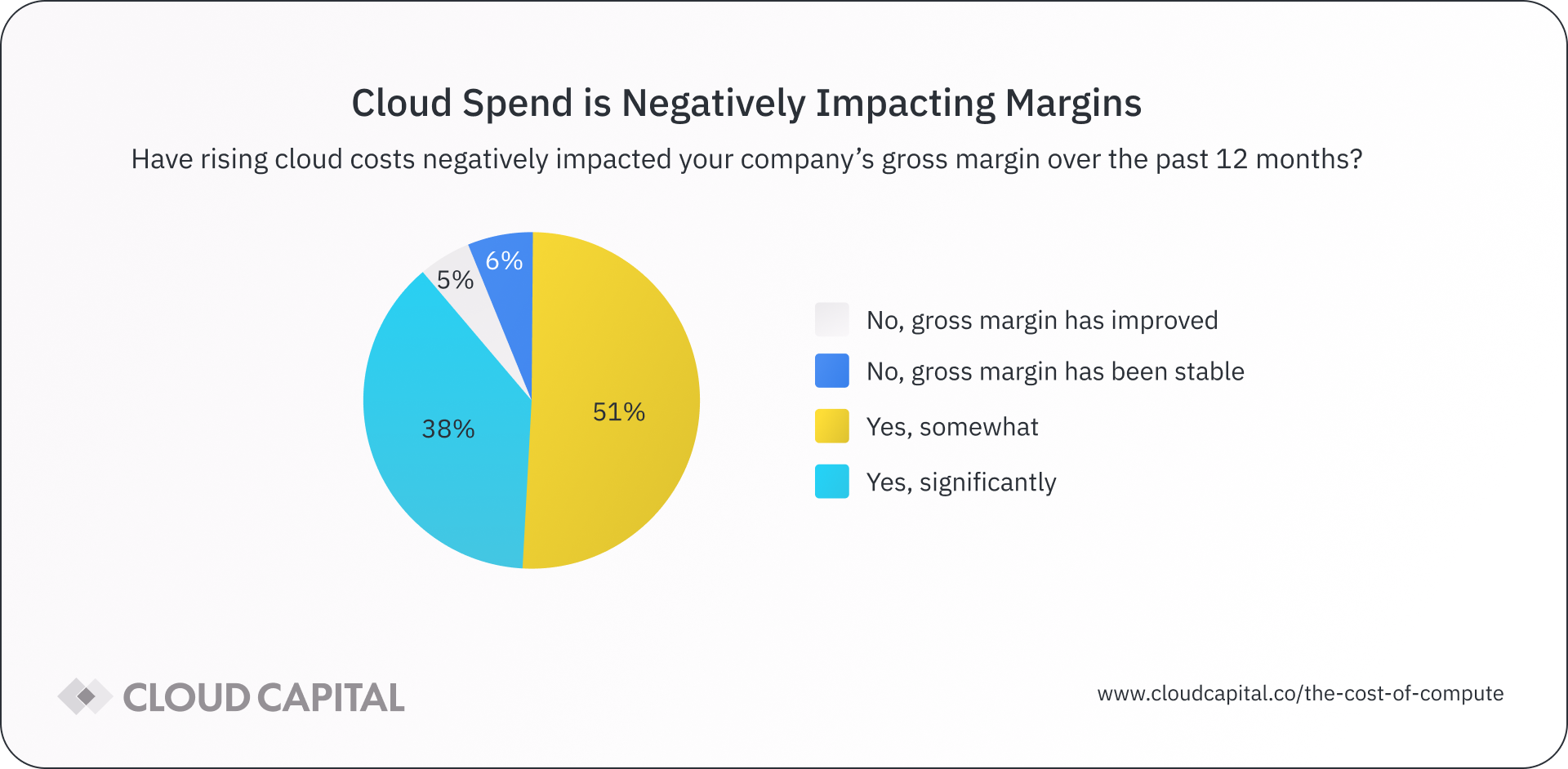
The severity varies. 38% describe the impact as significant. Another 51% call it somewhat negative. Only 11% report no margin pressure from cloud costs at all. The signal is too loud to dismiss as operational noise. It’s a structural risk to gross margin, valuation, and the CFO’s credibility with the board.
Cloud has reached headcount-level materiality in the P&L, but it’s being managed with far less rigor. That mismatch is what’s crushing margins.
This analysis draws on Cloud Capital's Q4 2025 CFO Survey of 100 senior finance leaders at growth-stage technology companies (50–1,000 employees, US and UK). All margin and forecast references reflect the 12 months preceding the October 2025 survey. For full methodology, see The Cost of Compute 2026.
The math is straightforward. Cloud infrastructure now represents 10-20% of revenue for most growth-stage SaaS companies, making it the second or third-largest expense category after headcount. At this scale, cloud carries the same financial weight as your engineering team or your go-to-market function.
And it's growing. 80% of CFOs report that cloud spend as a percentage of revenue increased over the past 12 months. More than half saw increases of 2-5 percentage points. Another 10% saw increases exceeding 5 points. Just 1 in 10 managed to reduce cloud's share of revenue.
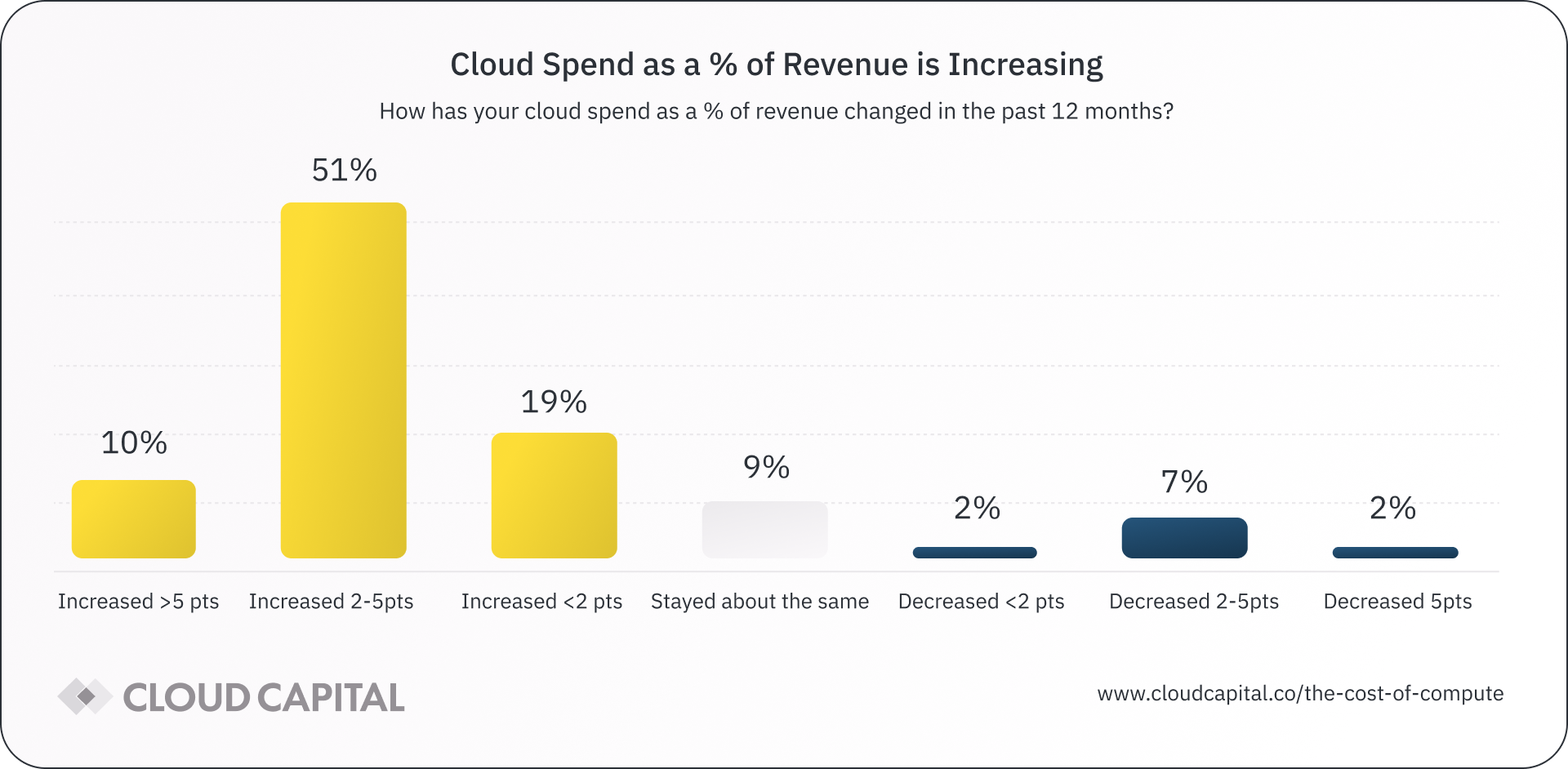
When a material cost line grows faster than revenue, it mathematically pressures margins. This is true for any expense category. What makes cloud different is that Finance rarely sees it coming with the precision applied to other costs at comparable scale.
Consider how Finance treats headcount. When you add engineers, you model the fully-loaded cost, forecast the ramp, and build it into margin projections before the offer letter goes out. The expense is large, but it's planned. Cloud costs arrive differently. They scale with usage patterns Finance doesn't control, architectural decisions Finance doesn't make, and workload characteristics Finance often can't see until the bill arrives.
The result is an expense category that carries headcount-level materiality but behaves with variance levels Finance wouldn't tolerate anywhere else.
Rising cloud costs are a problem. Unpredictable cloud costs are a bigger one.
74% of CFOs report monthly cloud forecast variance of 5-10% or more. Only 26% achieve the precision Finance expects for expenses at this scale: variance of 5% or less.
To contextualize this level of variance, consider how other major expense categories perform. Headcount, often 70% of SaaS costs, stays within ±2-3% of forecast. Fixed expenses like rent and insurance rarely deviate more than 2%. If headcount projections missed by 7% each month, the CFO would face immediate board scrutiny. For cloud costs, this level of variance has become normalized despite comparable materiality.
Cloud is the only 10–20% line item where Finance routinely tolerates 5-10%+ monthly variance and low control. If you mapped these numbers onto headcount, every CFO would call them unacceptable.
The comparison reveals the control gap. Finance maintains tight control where it has organizational ownership, forecasting discipline, and clear accountability. Cloud, despite its size, falls outside that pattern.
Why does this create margin pressure? Because unpredictable costs are harder to offset, harder to plan around, and harder to explain to boards. When cloud comes in 7% over forecast, Finance scrambles to find offsets elsewhere or absorbs the hit to margin. When it happens month after month, the cumulative drag becomes a structural headwind rather than an episodic surprise.
Variance creates a second-order problem that may matter even more than the direct cost impact: Finance loses confidence in its own numbers.
Only 57% of CFOs express high confidence in their cloud Cost of Goods Sold reporting accuracy. The remaining 43% describe their confidence as "somewhat" or acknowledge that data is incomplete or unclear.
This is a credibility problem. Projections become much harder to defend when the primary COGS-driver fluctuates at 5-10%+ monthly variance and Finance can't precisely measure it. The CFO who can confidently explain headcount, fixed costs, and every other major expense line now finds cloud infrastructure stubbornly unpredictable despite its demonstrated impact on profitability.
Boards expect precision on material line items. They expect Finance to know why costs moved, whether the movement was planned, and what levers exist to course-correct. When the answer is "cloud came in hot and we're still figuring out why," credibility erodes.
The 89% reporting margin pressure aren't describing a one-time surprise, but an ongoing condition where a material expense behaves in ways Finance can't fully anticipate or control. That condition creates friction in every board conversation, every margin forecast, and every investment decision that depends on knowing where gross margin will land.
The 89% figure is striking, but the 11% who report no margin pressure are equally instructive. What separates them?
Cross-tabulating the survey data reveals a clear pattern. Among organizations with joint Finance-Engineering ownership of cloud costs, 35% report no negative margin impact. Among organizations where Engineering owns cloud costs alone, that figure drops to 0%. Every Engineering-owned organization in the sample reported some degree of margin pressure from cloud.
Finance involvement changes how organizations experience and manage that growth. Cloud costs become a managed variable rather than an absorbed surprise.
A second pattern emerges around governance maturity. Organizations with fully implemented governance policies (budget caps, approval workflows, tagging rules) are actually more likely to report significant margin impact: 50% versus 20% for organizations with only partial governance.
The CFOs with the best instrumentation are simply the first to see how big the issue really is. Organizations with partial governance may experience the same underlying cost dynamics but lack the instrumentation to attribute margin pressure to cloud specifically.
This insight matters for Finance leaders evaluating their own cloud cost maturity. Feeling the pressure isn't a sign of failure. It may be a sign that you're finally seeing what was always there.
The pressure isn't going away. 73% of CFOs expect cloud spend as a percentage of revenue to increase over the next 12 months. Nearly half anticipate 2-5 percentage point increases. Another 11% expect growth exceeding 5 points.
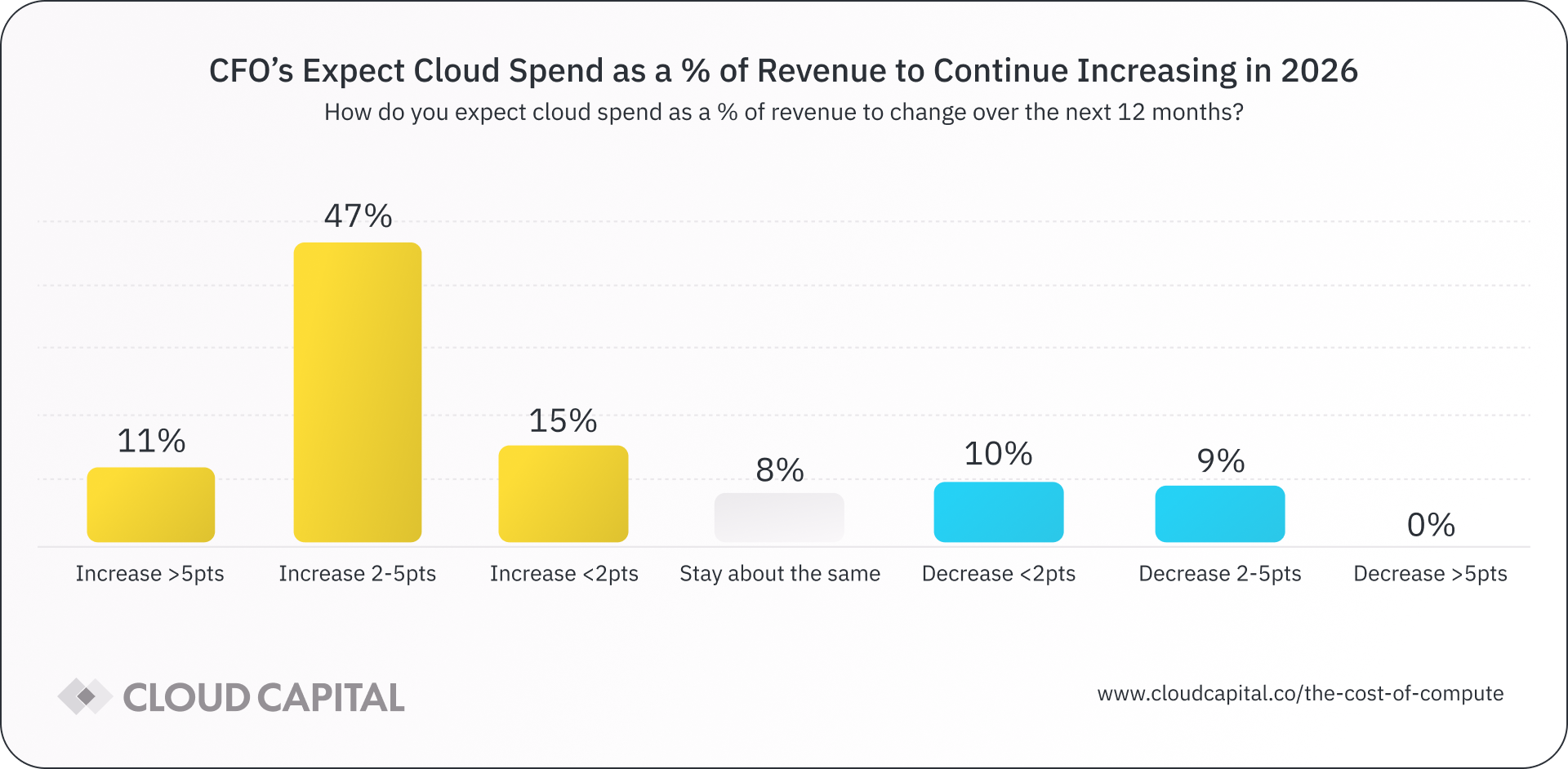
Margin pressure on a growing base compounds. If cloud at 15% of revenue creates headwinds today, cloud at 20% will create larger headwinds next year.
AI workloads are accelerating that trajectory. AI and ML already account for 22% of cloud spend across the survey population, and organizations with major AI exposure report margin pressure at 2.6× the rate of those with moderate AI contribution.
For Finance, the challenge is that AI costs break the familiar patterns that made traditional infrastructure forecastable in three important ways:
For organizations fine-tuning models or running experiments, training and experimentation introduce episodic spikes as well. These patterns amplify the variance problems CFOs already face on cloud, which is why AI-heavy organizations without full governance and monthly forecasting show meaningfully higher margin risk than peers with the same AI exposure but better operational infrastructure.
The organizations that build predictable systems now will absorb that growth without surrendering control or margin. The organizations that continue managing cloud reactively will feel increasing pressure as the line item consumes a larger share of revenue.
The question is whether you'll apply the same rigor to cloud that you apply to headcount and fixed expenses, or continue absorbing variance on a line item too large to leave unmanaged.
Report
Download The Cost of Compute 2026
Cloud Capital earns a share of the savings we generate for you. If you don't save, we don't get paid. Our incentives are fully aligned with yours. Ready to take control of your cloud spend?


